

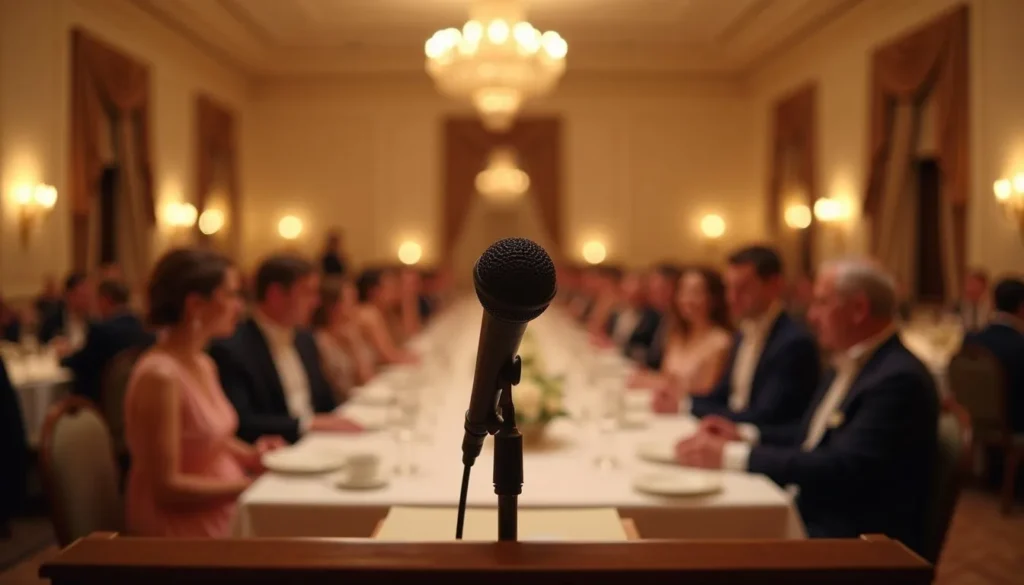
Last summer, I found myself sitting at a reception table in a converted barn in upstate New York, clutching a damp cocktail napkin and feeling my heart thumping against my ribs. I wasn’t even the one giving the speech, but my best friend was, and I was so nervous for her that I could barely swallow my salad. She had been stressing for weeks, staring at a blank Google Doc and wondering how on earth you summarize fifteen years of friendship into three minutes without sounding like a Hallmark card or, even worse, a rambling mess that everyone tunes out to check the score of the game.
When she finally stood up, she didn’t read from a script. She looked at the bride, told a story about a failed road trip involving a flat tire and a very expensive bag of beef jerky, and by the end, there wasn’t a dry eye in the room. It wasn’t because she was a professional writer. It was because she understood that a great wedding speech isn’t a performance. It is a gift.
Most of us treat the wedding speech like a high school oral exam we didn’t study for. We get caught up in the “rules” and the pressure to be funny or profound, and we end up falling back on clichés that guests have heard a thousand times. If you have been asked to give a toast, whether you are the Maid of Honor, the sister of the groom, or a bold best friend, you have a huge opportunity. You are the one who gets to bridge the gap between the couple and the guests. Here is how to write a speech that people will actually talk about at the brunch the next morning for all the right reasons.
Start with the “Who” and the “Why”
Before you even think about being funny or sentimental, you have to ground the room. There are people at that wedding who have no idea who you are. Maybe you are a cousin from the other side of the country or a work friend they have never met.
The first thirty seconds should be used to introduce yourself and establish your connection to the bride or groom. But do not just say your name and your title. Give it a little bit of flavor. Instead of “I am Sarah and I am the Maid of Honor,” try something like, “I am Sarah, and I have been the unofficial third wheel in this relationship since their second date at that terrible dive bar.” It breaks the ice and gives the guests a reason to listen to you.
The Power of the “One Specific Story”
The biggest mistake people make is trying to summarize the person’s entire life. You cannot cover childhood, high school, college, and the engagement in five minutes. When you try to do too much, the speech becomes a list of dates and facts, which is boring.
Pick one story. Just one. This story should be a “window” into who the person is. It shouldn’t be about a time they were perfect. It should be about a time they were uniquely themselves. Maybe it is the time they stayed up all night helping you move, or the time they insisted on wearing a ridiculous costume to a serious party. A story about a flaw or a funny quirk is always more endearing than a list of virtues. If you can make the guests feel like they know the person a little bit better through your story, you have already won.
Address the Partner Directly
This is the part that many people forget. If you are the bride’s sister, it is easy to spend the whole time talking about your childhood together. But this is a wedding, not a birthday party. You have to talk about the person they are marrying.
You don’t even have to know the partner that well to do this effectively. You just have to talk about how the partner has changed your friend. Does your friend laugh more now? Are they more adventurous? Do they seem more at peace? Tell the partner, “I knew she was in good hands when I saw the way she looked at you after that long week,” or “Thank you for being the person who finally figured out how to calm her down when she is stressed.” It shows that you support the union, not just your friend.
Keep the Humor “Inside” but Accessible
We all love a funny wedding speech, but there is a fine line between a good joke and an inside joke that leaves the rest of the room feeling left out. If you have to say “you had to be there,” you shouldn’t tell the story.
Avoid embarrassing the couple in a way that feels mean-spirited. This isn’t a roast. If the story involves an ex-boyfriend, a legal issue, or something that would make the bride’s grandmother faint, leave it out. The best kind of humor is self-deprecating. Make a joke about your own lack of coordination or your shared obsession with a weird TV show. When you are the “butt of the joke,” the audience feels comfortable laughing along with you.
The “No-Fly Zone” of Clichés
If you find yourself writing the words “Webster’s Dictionary defines marriage as,” please hit the backspace button immediately. Also avoid things like “it feels like just yesterday,” or “the lucky guy who caught her.”
These phrases are filler. They take up space but they don’t add value. When you use a cliché, the guests’ brains go on autopilot because they already know where the sentence is going. Try to describe things in your own voice. Instead of saying they are a “perfect match,” describe how they balance each other out like a well-timed playlist. The more original your language, the more the speech will feel like a real conversation.
Practice Out Loud (and Time Yourself)
Writing the speech is only half the battle. You have to say it. A speech that looks great on paper might be a tongue-twister when spoken.
Read your speech out loud to a friend or even to your dog. Look for places where you stumble or where the sentences are too long. When we get nervous, we tend to talk faster, so build in “breathing breaks.” Most importantly, keep it under five minutes. Three minutes is actually the “goldilocks” zone for a wedding toast. It is long enough to be meaningful but short enough that you leave them wanting more. If you see people starting to reach for their wine glasses, it is time to wrap it up.
The Toast is the Finish Line
End your speech on a high note with a clear “call to action.” Tell everyone to raise their glasses. This is the moment to be sincere.
Don’t worry about being “too cheesy” here. A wedding is the one place where sincerity is expected. Give a simple, beautiful wish for their future. Use their names. Look them in the eye. When you say “To the happy couple,” make sure you mean it. That final moment of connection is what sticks with people as the music starts back up and the dancing begins.
A Quick Checklist for Success
- Intro: Who are you and how do you know them?
- Body: One specific, funny, or touching story.
- Bridge: How has the partner changed or improved them?
- Closing: A sincere wish and a “Cheers!”
- Length: 3 to 5 minutes max.
- Medium: Use paper or a card, not your phone (phones look bad in photos and might go dark).
Final Thoughts
The best wedding speeches aren’t the ones that are perfectly polished. They are the ones that feel honest. If your voice shakes a little bit, that is okay. If you have to take a second to wipe away a tear, that is even better. Your guests aren’t looking for a stand-up comedian or a professional orator. They are looking for a reason to celebrate the love in the room. If you speak from a place of genuine affection and keep the focus on the couple, you will give a speech that they will treasure forever.
