

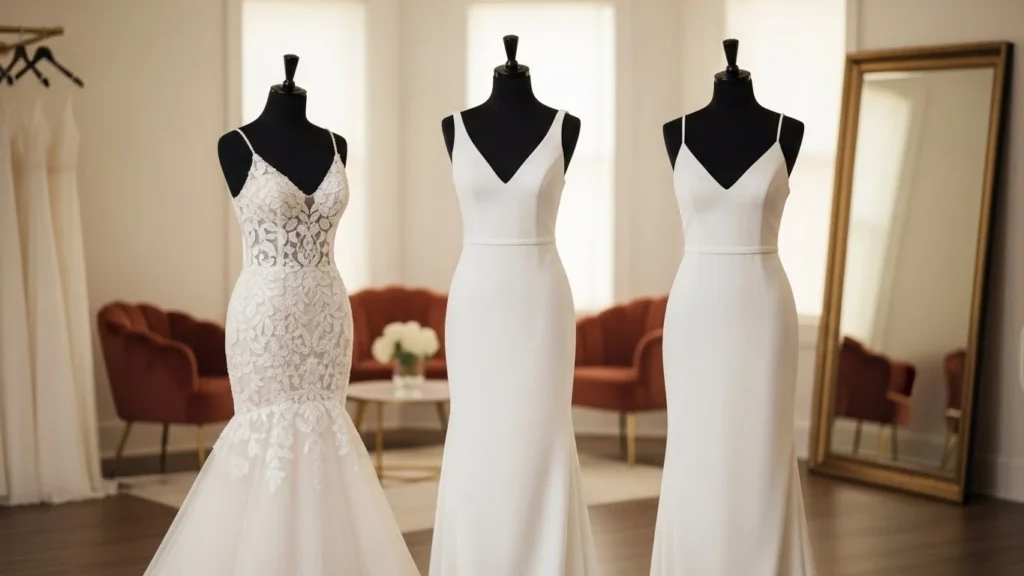
I remember standing in front of a three way mirror in a boutique in downtown Chicago, wearing a dress that looked like a million bucks on the mannequin but made me look like a confused marshmallow. I was so frustrated. I had done all the “research,” I had saved all the right photos, but the reflection looking back at me just felt wrong. It took me three more shops to realize that I wasn’t the problem. My body wasn’t “wrong” for the clothes. I was just trying to force a shape that didn’t actually celebrate where I was strongest and most beautiful.
Shopping for a wedding dress is an emotional minefield. We are told from a young age that this is the most important outfit we will ever wear, which is a massive amount of pressure to put on a piece of white fabric. Then you add in the “body type” conversation, which often feels like a list of things you should hide or fix.
I want to flip that script. Picking a dress for your body type isn’t about “correcting” your shape. It is about architecture. It is about finding the lines and the fabrics that work with your natural frame so you can stop worrying about how you look and start focusing on the fact that you’re getting married. Whether you are curvy, athletic, petite, or somewhere in between, there is a silhouette that is going to make you feel like the most powerful version of yourself. Here is how to find it without losing your mind.
The Pear Shape: Highlighting the Narrowest Point
If you are someone who carries your weight in your hips and thighs but you have a smaller bust and waist, you are likely what the fashion world calls a pear shape.
The goal here is usually to balance out your proportions. An A-line dress is the absolute gold standard for this. Because the skirt flares out from the natural waist, it glides right over the hips without clinging. It puts all the focus on your waist, which is usually your narrowest point.
If you want to add even more balance, look for a dress with some detail on the top. A boat neck or off the shoulder sleeves can help broaden your shoulders visually, which creates a really beautiful, symmetrical look. Don’t feel like you have to hide your bottom half, but if comfort is a priority, the A-line gives you plenty of room to move and dance without feeling restricted.
The Hourglass: Embracing the Curves
If your bust and your hips are about the same width and you have a well defined waist, you’ve got that classic hourglass figure.
You have two choices here. You can either soften the curves with an A-line, or you can lean all the way into them with a mermaid or trumpet silhouette. A mermaid dress is basically made for the hourglass body. It hugs the chest, waist, and hips tightly before flaring out. It is a high drama look that celebrates every curve you have.
If you go this route, just remember what we talked about regarding mobility. Make sure the “flare” starts high enough that you can actually walk. Another great option for hourglass shapes is a wrap style dress or anything with a built in belt. Highlighting that narrow waist is always going to be your best bet for a flattering fit.
The Apple Shape: Creating Length and Line
If you carry most of your weight in your midsection and you have a full bust but slimmer legs, you are often categorized as an apple shape.
For you, the empire waist is a total game changer. By raising the waistline to right underneath the bust, the fabric falls away from the stomach and creates a long, lean line down to the floor. It is incredibly comfortable and looks very ethereal.
Another tip for apple shapes is to look for a V-neckline. This draws the eye vertically rather than horizontally, which helps elongate your torso. Avoid heavy belts or thick fabric right at the widest part of your stomach, as these can feel bulky. Instead, look for light, flowing fabrics like chiffon that move with you and feel weightless.
The Athletic or Rectangular Shape: Building Dimension
If you are straight up and down with shoulders, waist, and hips that are roughly the same width, you have an athletic build. You might feel like dresses “hang” on you rather than fitting you.
The secret for an athletic body is to create the illusion of curves where they might not naturally be as prominent. A ball gown is amazing for this because the volume of the skirt creates a waistline by sheer contrast.
You can also look for dresses with strategic cutouts or “contour” stitching. These are seams that curve inward at the waist to give you more of an hourglass look. If you love a sleek look, a sheath dress can also be stunning on an athletic frame, especially if it has a high neck or a low back to show off your muscle tone. You have the “frame” to carry off some of the more architectural, high fashion looks that might overwhelm someone with more curves.
The Petite Bride: Not Getting Lost in the Fabric
If you are on the shorter side, the biggest struggle is often the “marshmallow” effect. Too much fabric can make it look like the dress is wearing you instead of the other way around.
The goal for petite brides is to create height. A sheath dress or a column dress is perfect because there is no horizontal line to “break” your body in half. It is one continuous vertical movement from your head to your toes.
If you really want a big skirt, go for a modified A-line rather than a full ball gown. You want the skirt to be proportional to your height. Also, be careful with very high necklines or long sleeves, as they can sometimes make you look “closed in.” Showing a bit of skin at the neckline or choosing a sleeveless style can help you look taller and more open.
The Busty Bride: Support and Sophistication
If you have a large chest, the main concern is usually support and modesty. You want to feel secure so you aren’t pulling your dress up all night.
Look for dresses with a slightly higher back. A dress that is low in the front and low in the back is very hard to support because there is no “anchor” for the bodice. A scoop neck or a sweetheart neckline with sturdy straps is usually more comfortable than a strapless gown.
If you love the strapless look, make sure the dress has a very high quality internal corset or boning. You want the waist of the dress to hold the weight of the bust so your shoulders don’t have to do all the work. Avoid “boat necks” or very high, flat necklines if you don’t want to look top heavy, as they can create a “wall of fabric” effect.
Three Questions to Ask Your Reflection
Before you get too caught up in the “rules” of body types, I want you to look at yourself in the mirror and ask these three things:
1. Where is my eye going first? If your eye immediately goes to a part of your body you feel self conscious about, the dress isn’t doing its job. The dress should lead the eye to your face or to your favorite feature, like your shoulders or your waist.
2. Can I breathe? I know it sounds basic, but if you are “sucking it in” to make a silhouette work, it isn’t the right silhouette for you. The right dress should feel like a second skin, not a cage.
3. Do I feel like a “bride” or do I feel like a “costume”? Sometimes we pick a dress because it fits our body type perfectly, but it doesn’t fit our personality at all. If you are a casual, low key person, a massive “pear shaped” ball gown might make you feel like you are playing a part in a play.
Final Thoughts
Your body type is just a starting point. It is a map, not a destination. Use these “rules” to help you narrow down the thousands of options out there, but don’t let them stop you from trying on something that breaks all the rules.
The most beautiful thing a bride can wear is confidence. When you find a dress that makes you feel like you don’t need to change a single thing about yourself, that is your dress. It doesn’t matter if it’s “supposed” to work for your shape or not. If you feel like a goddess, everyone else is going to see a goddess.
Take a breath, trust your gut, and remember that the person at the end of the aisle loves your body exactly as it is right now. That is the only opinion that really counts.
